Restaurant social media marketing is the discipline most independent owners think they understand until the posting stops. The real problem is not content ideas or platform choice; it is the operational gap between having a plan and having someone who owns the daily publish-and-respond loop. This guide closes that gap with a step-by-step workflow built for owner-operators, not marketing agencies.
Key Takeaways
- Ownership beats strategy: the single biggest reason independent restaurants quit social media within 90 days is not a content problem, it is that no one explicitly owns the publishing, community management, and monthly measurement cycle once content is approved.
- Platform choice is a venue decision: casual venues and shisha lounges benefit most from TikTok's discovery algorithm, while fine dining and cafes tend to convert better from Instagram's intent-driven browse behaviour. Matching platform to venue type matters more than chasing follower counts.
- Measure table covers, not likes: reach-to-reservation rate, story link-tap rate, and profile-visit-to-DM conversion are the three metrics that actually correlate with revenue. Follower count and post likes tell you almost nothing about whether your strategy is working.
What is restaurant social media marketing and why does it matter for local venues?
Restaurant social media marketing is the practice of using platforms such as Instagram, TikTok, and Facebook to attract, convert, and retain diners through consistent content, community engagement, and platform-optimised listings. For independent venues, it functions as the primary discovery channel, replacing the role that word-of-mouth and print once played in driving first visits and repeat bookings.
The scale of that shift is no longer incremental. According to restaurant social media marketing statistics, 72% of people now use social media to research restaurants, and 68% check a venue's social presence before visiting. That means a dormant or inconsistent account is not neutral. It actively costs you covers.
"Restaurants that treat social media strategically report an average 9.9% increase in consumer revenue attributed directly to social activity, a figure consistent across multiple independent research sources." — Deloitte Digital, 2025 State of Social research
The revenue case is not theoretical. For a venue doing solid annual turnover, a 9.9% lift attributable to a consistent social presence is a material number. The operative word is consistent, not prolific. Volume without a system produces the sporadic posting pattern that most independent operators fall into, and then abandon.
How social platforms have replaced search for dining decisions
Diners used to open Google when they wanted to find somewhere new. Now, a significant portion of that intent begins on TikTok's For You Page or Instagram's Explore feed. Content surfaces based on relevance and engagement, not proximity alone, which means a well-crafted Reel from your kitchen can reach a prospective guest who has never heard of you and was not actively searching.
Google Business Profile still matters for closing intent, someone who has already decided to look for you. Social platforms are where the decision to look is made in the first place. Both layers need attention, but the discovery work happens on social.
Step 1: Choose the right platforms for your restaurant type and audience
Generic advice tells you to be on Instagram, TikTok, and Facebook. In practice, spreading a small team across three platforms with no ownership model guarantees mediocrity on all three. The more useful question is: which single platform drives the highest-intent discovery for your specific venue type, and where does your secondary effort go?
According to social media statistics for restaurants and hospitality brands, TikTok's average engagement rate has climbed to 3.70%, compared with Instagram at 0.48% and Facebook at 0.15%. The gap reflects distribution model differences: TikTok pushes content aggressively to non-followers, while Facebook's organic reach is structurally limited. For venues that want discovery from people who do not yet know them, that asymmetry matters.
Casual dining — Primary Platform: TikTok · Secondary Platform: Instagram · Content Priority: Behind-the-scenes, specials · Key Metric to Watch: For You Page reach
Fine dining — Primary Platform: Instagram · Secondary Platform: Google Business Profile · Content Priority: Plating, ambience, events · Key Metric to Watch: Profile-visit-to-DM rate
Cafe — Primary Platform: Instagram · Secondary Platform: TikTok · Content Priority: Morning ritual, seasonal drinks · Key Metric to Watch: Story link-tap rate
Shisha lounge — Primary Platform: TikTok · Secondary Platform: Instagram · Content Priority: Atmosphere, night ambience · Key Metric to Watch: DM-to-booking conversion
On hashtag strategy, local city hashtags consistently outperform generic food hashtags for discovery. A hashtag specific to your city surfaces your content to people who are physically able to visit. A generic hashtag like #foodporn distributes it globally to an audience that almost entirely cannot.
- Instagram Reels: prioritise for reach and non-follower discovery; static carousels deepen engagement with existing followers.
- TikTok For You Page: the most powerful organic discovery surface available to independent venues, but it requires consistent posting rhythm to train the algorithm.
- Google Business Profile: not social in the traditional sense, but it closes intent that social content opens. Keep photos, hours, and posts current.
- Facebook: strongest for event promotion and community groups in cities with active local dining scenes; weakest for organic discovery.
Soovita's Instagram management for restaurants and cafes handles the platform-specific content production and scheduling that most kitchen-first teams cannot sustain alone.
Step 2: Build a content system your team will actually maintain
The mistake most teams make here is treating content planning and content publishing as the same decision. They are not. You can have a full content calendar planned on Sunday evening and still have nothing posted by Wednesday if no single person is accountable for the publish-and-respond loop each day. That gap is where independent restaurant social media strategies die.
Pro Tip: Assign publishing ownership to one named person, not a role, before you plan a single post. If that person is unavailable, name a specific backup. A two-person operation can rotate weekly, but the rotation must be explicit and written down.
The three content pillars every restaurant account needs
- Product content: food, drinks, and physical space shown at their best. This anchors what you sell and gives prospective guests a reason to choose you over the place two doors down.
- Process content: preparation, sourcing, and kitchen moments. This builds trust and personality in a way finished-dish photography cannot. A 20-second clip of a sauce being finished tells a story a menu description never will.
- Social proof content: reshared user-generated content, positive review callouts, and guest moments. This is your lowest-cost acquisition channel because the content already exists and arrives pre-validated by a real person.
A realistic weekly posting rhythm for a two-person operation
Three posts per week on your primary platform and two Stories per day is a sustainable floor for most independent venues. That is not a content volume recommendation; it is the minimum cadence that keeps platform algorithms treating your account as active. Below that threshold, organic reach decays measurably between posting sessions.
Watch Out: A content calendar that is fully planned but lacks a named person responsible for each post's final upload and first-hour comment response will stall within three weeks. Planning and publishing are separate jobs. Treat them that way.
Step 3: Turn comments, DMs, and reviews into a community that books tables
Broadcasting is the entry point of social media marketing for restaurants. Community management is where it starts converting. Prospective diners who have never visited your venue routinely read comment sections before making a booking decision. What they find there, quick genuine responses or silence, is as influential as the content itself.
Response speed matters on two levels simultaneously. Algorithmically, platforms weight early comment activity as a signal of content quality, boosting reach. Commercially, unanswered DMs translate directly to lost bookings. Research indicates that nearly 73% of consumers will choose a competitor if a restaurant does not respond to messages promptly. That is not a soft preference; it is a booking decision made in your absence.
- Positive comments: respond within two hours during business hours. A specific reply, referencing what the guest mentioned, signals to readers that a real person runs this account.
- Unanswered DMs: set a four-hour response window as a floor. Anything longer and the prospective guest has already booked elsewhere. Pin your booking link or reservation method in your bio so the answer is available even before you respond.
- Negative comments and reviews: respond publicly, briefly, and without defensiveness. Prospective guests reading the exchange are the real audience. A calm, solution-oriented reply to a complaint converts observers more effectively than five positive posts.
- User-generated content: ask permission, then reshare. UGC carries social proof that brand-produced content cannot replicate. Consumers find UGC significantly more impactful than brand content when making a purchasing decision.
Pro Tip: Create a shared document with three to five approved response templates for the most common DM types: reservation enquiries, allergen questions, and complaint acknowledgements. Templates are a starting point, not a script. Personalise one detail in every reply.
For venues managing review volume across Google, delivery apps, and social platforms simultaneously, Soovita's review reply service for local hospitality venues handles the response workflow so the owner can focus on the floor.
Step 4: Measure what moves the needle, not just follower count
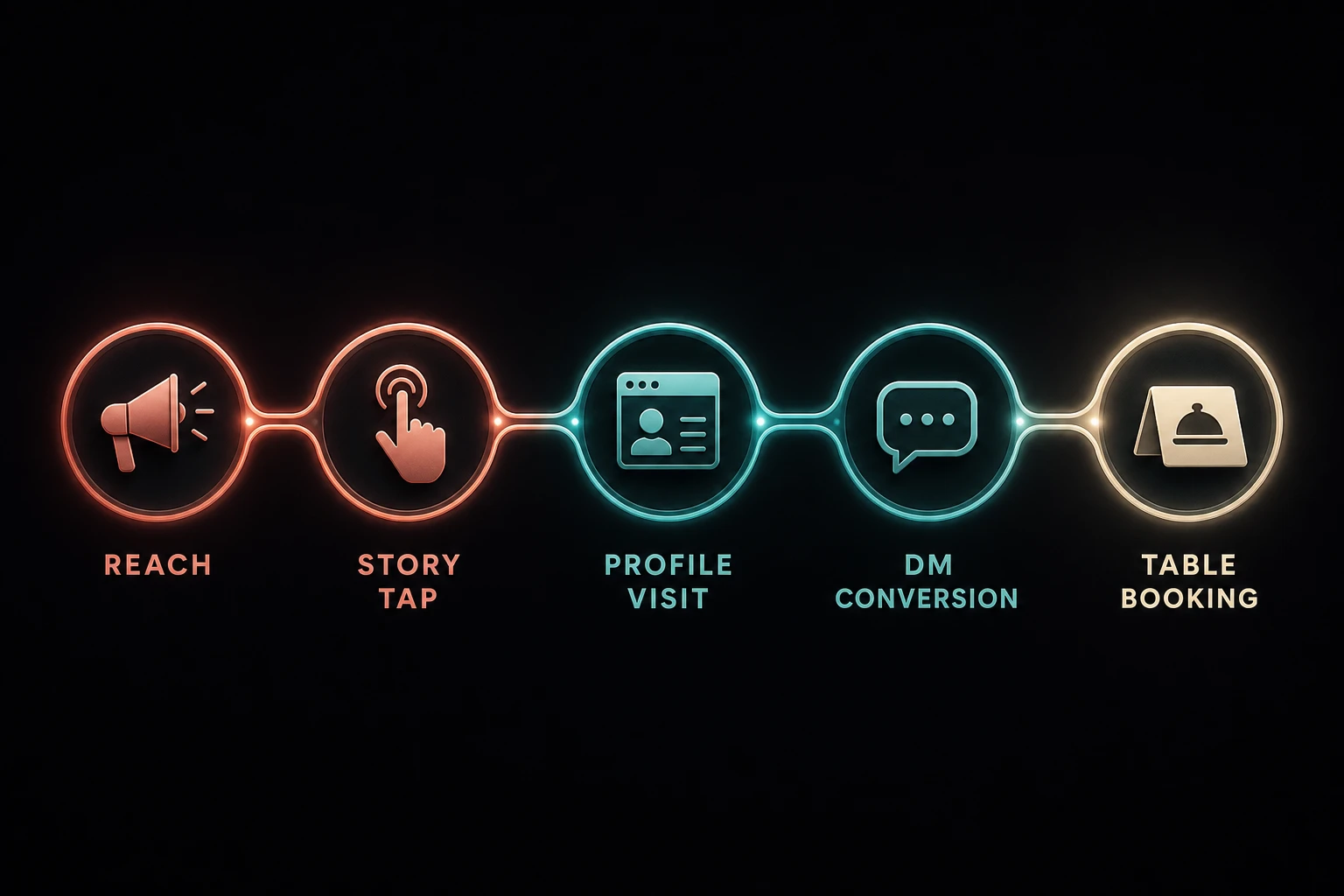
Follower count is the metric that feels most like progress and correlates least with revenue. An account with 800 engaged local followers who regularly tap through to a booking link outperforms an account with 8,000 followers accumulated through giveaways or untargeted content. The three metrics that actually matter for independent venues are:
Reach-to-reservation rate — What It Measures: Percentage of reached accounts that convert to a booking action · Where to Find It: Native Insights + booking link clicks · Target Signal: Trending upward monthly · Vanity Alternative to Ignore: Total impressions
Story link-tap rate — What It Measures: Percentage of Story viewers who tap your reservation or menu link · Where to Find It: Instagram Story metrics · Target Signal: Above 3% is strong for hospitality · Vanity Alternative to Ignore: Story views in isolation
Profile-visit-to-DM conversion — What It Measures: Percentage of profile visitors who send a message · Where to Find It: Native Insights · Target Signal: Above 1% suggests strong intent · Vanity Alternative to Ignore: Profile visits alone
All three metrics are available inside native platform analytics on both Instagram and TikTok. No third-party tool is required to run a monthly audit. Block 30 minutes on the first Monday of each month, export the previous month's figures for these three metrics only, and compare them to the prior month. If reach grows but DM conversion does not, the problem is in your bio or booking friction, not your content.
- Monthly audit step one: pull reach, Story link taps, and profile-visit-to-DM rate from native analytics for the last 30 days.
- Monthly audit step two: identify the three posts with the highest reach and the three with the lowest. Look for format and topic patterns, not individual post performance.
- Monthly audit step three: adjust the following month's content calendar based on format patterns, not gut feel. Document the decision so you can reverse-engineer what worked in three months' time.
For venues running on delivery platforms alongside dine-in, link social traffic data to order volume by checking whether delivery app visit spikes follow high-reach posting days. Soovita's delivery app listing optimisation for Tallinn restaurants ensures that the traffic social content generates lands on a listing that converts.
Frequently Asked Questions
What social media platform is best for restaurant marketing?
For most independent restaurants and casual venues, TikTok offers the strongest organic discovery reach because its algorithm actively distributes content to non-followers. Instagram performs better for fine dining and cafes where visual browse intent is high and a profile-visit-to-DM conversion matters. The best platform is the one your team can post on consistently, not the one with the highest theoretical engagement ceiling.
How often should a restaurant post on social media?
A sustainable minimum for most independent venues is three feed posts per week on the primary platform plus two Stories per day. Below that cadence, platform algorithms treat the account as inactive and suppress organic reach between sessions. Consistency across 90 days outperforms a burst-and-stall pattern every time. Assign one named person to own publishing before deciding on volume.
Does social media marketing actually increase restaurant revenue?
Yes, when the approach is strategic rather than sporadic. Restaurants that treat social media as a managed channel, with consistent posting, active community management, and measurement against booking metrics, reported an average 9.9% increase in direct business-to-consumer revenue, according to Deloitte Digital's 2025 State of Social research. Sporadic or unmanaged social activity does not produce the same result.
The operational gap is the strategy
Every restaurant social media strategy eventually comes down to one question: who is doing the work tomorrow morning? Platform choice, content pillars, and measurement frameworks are only useful if someone owns the daily publish-and-respond loop after the planning session ends. Build that ownership into your workflow before you touch a content calendar.
Start by assigning publishing and community management responsibility to one named person this week. Then build your three content pillars, set your posting rhythm, and run your first 30-minute monthly audit after four weeks. The venues that sustain a social media presence are not the ones with the most creative content. They are the ones with the clearest internal ownership.
If you are at the point where the workflow is clear but the execution capacity is not, see how Soovita manages Instagram content, publishing, and community management for independent restaurants and cafes.